
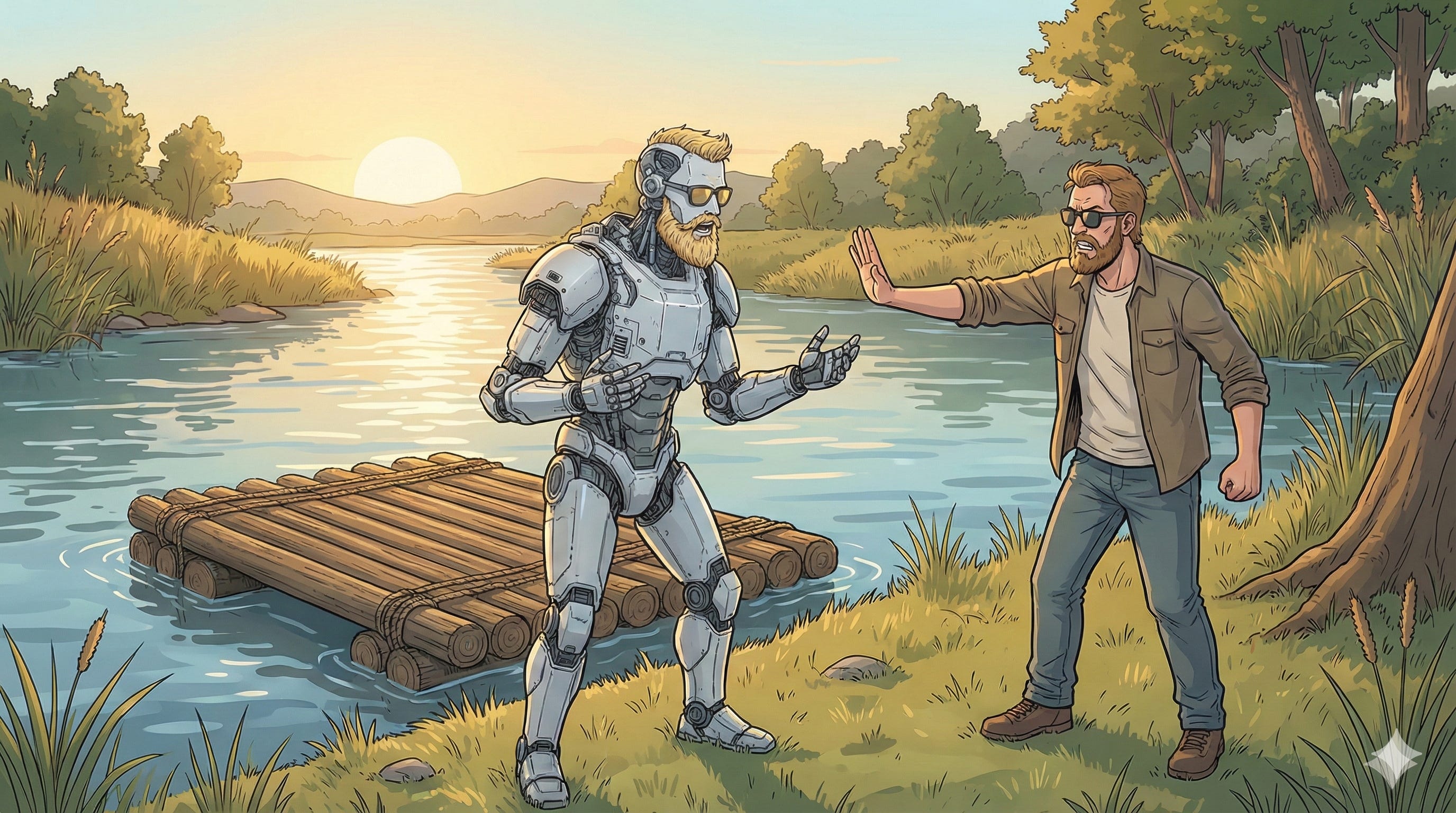
AI has become an incredibly tempting creative partner for me and from what I can see the people around me too.
It’s fast.
It’s fluent.
It always has something to say.
And that is exactly why it’s so easy to misuse, we take what it says as fact even though its just mimicking past information. Its not creating anything new.
Right now, we’re producing more content, more ideas, and more “creative output” than ever before. Yet much of it feels strangely familiar. Polished, coherent, and forgettable. This is not an accident. It’s a side effect of how AI actually works under the hood, and more creative people need to know this.
What is it creating?
Despite how it feels, AI is not imagining. It isn’t exploring the unknown, forming intent, or taking creative risks. It’s predicting what usually comes next based on what has already existed and what data it has been trained on.
Even its most impressive outputs are:
Recombinations of past patterns.
Statistical best guesses.
Echoes of what’s already been said.
This isn’t a flaw. It’s the core mechanism. AI is extraordinarily good at continuation.
It is not good at origination.
And confusing the two is where creativity starts to suffer, and this is what I see people doing all the time.
Where it can genuinely help.
Used well, AI is a actually a really powerful amplifier. It really shines when:
The idea already exists, but needs refining.
You’re exploring variations around a concept.
You want to break through a local creative block.
Speed matters more than originality.
Execution is the bottleneck, not thinking.
In these moments, AI acts like a multiplier to your own creative mindset. It helps you move faster, see adjacent possibilities and reduce friction once a direction is set.
This is where i am firm with my belief of AI usage. AI belongs: after intent, not before it.
So please do not have it open in early stages of any creative brief. It has no home here.
Where it undermines creativity.
The danger isn’t that AI replaces creativity as I mentioned above. The danger is that it collapses the creative space too early and people start using it instead of their own mind.
Ideas converge instead of have the freedom to diverge.
Th risk is smoothed out too early.
The novelty is replaced by plausibility.
And taste is overridden by probability.
AI is excellent at refining ideas, and terrible at discovering them. The moment you outsource the exploration phase to a system trained entirely on the past, you bias everything toward what already works, what already fits, what already feels safe.
That’s optimisation, not creativity and has no place in the work we do in creative thinking. This is a part of AI that can’t replace humans, so stop thinking it will.
Humans matter now more than ever.
In this AI-rich world, the value of the human doesn’t disappear / replace, it shifts us. Our human creativity lives in places AI can’t reach:
Exploring curiosity without a goal.
Feeling that discomfort when your presented with an obvious answer.
That feeling you get that can’t be explained.
Why we tend to intentional rule-break in solutionising.
Taking something and creating meaning, not just an output.
Humans notice when something feels wrong, boring, or too neat.
Humans explore directions without knowing where they’ll end up.
AI doesn’t do that, and I firmly believe that it never will.
Which means the human role in creativity isn’t shrinking. It’s becoming more important than ever, defiantly not less.
So here is my simeple rule of thumb.
Lets leave exploring to humans and use AI to accelerate.
Use AI when:
The idea is already formed
The direction is clear
You’re refining, scaling, or translating the ideas.
Speed over qulaity is the priority.
Avoid AI when:
You’re searching for the idea itself.
You’re defining voice or meaning.
You’re exploring new directions.
And when Taste and judgment matter most
AI should support creative intent, not find itself replace it because we have let it.
Let me know your thoughts in the comments below and subscribe to get more of my ideas around AI and future tech to your inbox.